A sectional garage door has three groups of parts. The counterbalance (springs, winding cones, center bearing plate, torsion tube, cable drums, lift cables and bottom brackets) carries the weight and stays under tension. The door and track (sections, hinges, rollers, tracks, struts and seals) guide it. The opener (rail, trolley, J-arm, drive gear, logic board and sensors) moves it.
Key takeaways
- The springs lift the door. The opener only guides it.
- Springs, winding cones, the center bearing plate, torsion tube, cable drums, lift cables and bottom brackets hold spring tension. Do not touch them.
- End hinges are numbered so the door closes snug against the jambs.
- Bottom bracket and bottom fixture are two names for the same part.
- Naming the part in a photo or a call gets you a faster, more accurate quote.
Knowing the name of each garage door part makes it easier to describe a problem, read a quote and know what to stay away from. The numbers match the diagram.
Safety first. Parts marked do not touch are under spring tension. Never unwind, adjust, loosen or remove a torsion or extension spring, a winding cone, the center bearing plate, the torsion tube, a cable drum, a lift cable or a bottom bracket. Never run the opener with a broken spring or a snapped cable, and keep people out from under a door that is crooked or jammed.
The parts of a garage door, labeled
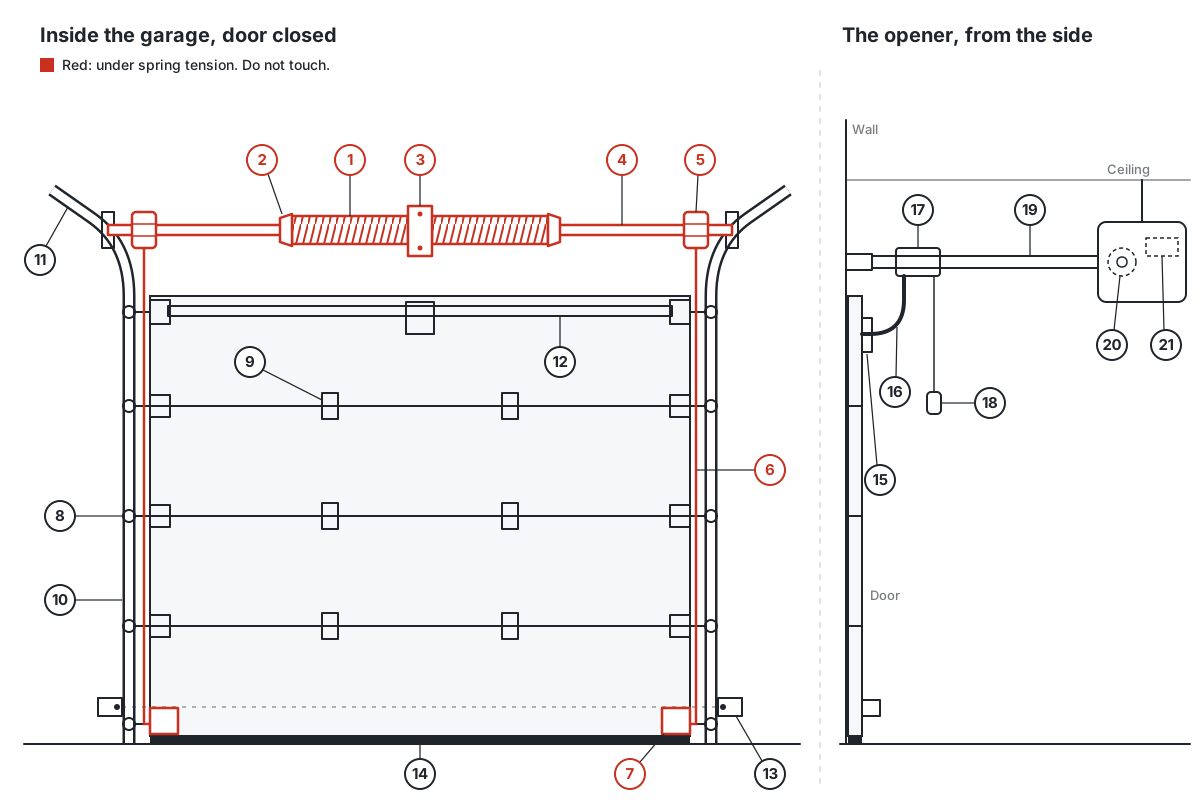
Red in the diagram means under spring tension.
- Torsion spring
- Winding cone
- Center bearing plate
- Torsion tube
- Cable drum
- Lift cable
- Bottom bracket
- Roller and stem
- Hinge
- Vertical track
- Horizontal track
- Strut
- Safety sensor
- Bottom seal and retainer
- Operator reinforcement bracket
- J-arm
- Trolley
- Emergency release cord
- Rail
- Drive gear and sprocket
- Logic board
Extension springs and winding bars are not drawn.
Springs and counterbalance parts
These parts carry the door’s weight under spring tension. Work on them is spring replacement or cable and drum replacement.
- Torsion spring (1). Do not touch. A torsion spring is a heavy steel coil on the torsion tube above the door that twists tighter as the door closes and unwinds to help lift it. Most doors built since the 1990s have one or two.
- Extension spring. Do not touch. An extension spring is a long spring beside each horizontal track that stretches as the door closes and pulls the lift cables over pulleys to raise it. They work in pairs, each with a safety cable through it. See torsion vs extension springs.
- Winding cone (2). Do not touch. A winding cone is the cast fitting at the outer end of a torsion spring, locked to the torsion tube with set screws, where the spring is wound. It holds the full tension of the spring.
- Winding bars. Winding bars are solid steel rods, sized to the holes in a winding cone, that technicians use to wind and unwind torsion springs. They are tools, not part of the door.
- Center bearing plate (3). Do not touch. The center bearing plate is the bracket bolted above the middle of the door that supports the torsion tube and anchors the fixed ends of the springs.
- Torsion tube (4). Do not touch. The torsion tube, or shaft, is the steel tube across the header that carries the springs and cable drums and turns as the door moves. On a Wayne Dalton TorqueMaster, the springs sit inside it (how to spot one).
- Cable drum (5). Do not touch. A cable drum is the grooved wheel at each end of the torsion tube that winds up the lift cable as the door opens. Set screws lock it to the tube.
- Lift cable (6). Do not touch. A lift cable is the braided steel cable running from the bottom bracket up to the cable drum, or over pulleys on an extension-spring door. If one frays or snaps, that side drops and the door hangs crooked.
- Bottom bracket or bottom fixture (7). Do not touch. The bottom bracket, also called the bottom fixture, is the steel bracket on each lower corner of the door that holds the lift cable and the bottom roller. It must never be unbolted while the springs are wound.
Door and track parts
- Roller and stem (8). A roller is the wheel that rides inside the track, and the stem is the shaft that holds it in a hinge or bracket on the door. Nylon rollers run quieter than steel ones. The bottom roller sits in the bottom bracket, so leave it alone.
- Hinge (9). Hinges join the sections, usually four or five, so the door can bend around the curve in the track. End hinges are numbered, usually starting with 1 at the lowest joint, and each higher number holds its roller farther from the door so the door closes snug against the jambs.
- Vertical track (10). The vertical tracks are the steel channels beside the opening that guide the rollers while the door is closed and starting to rise.
- Horizontal track (11). The horizontal tracks run from the curve at the top of the vertical tracks back along the ceiling and carry the door when it is open.
- Strut (12). A strut is a steel stiffener bolted across the inside of a section to stop it bowing. A 16 ft wide door usually has one or two across the top section. Bent struts and damaged sections are panel and section replacement.
- Bottom seal and retainer (14). The bottom seal is the rubber or vinyl strip along the bottom edge of the door that seals against the floor, and the retainer is the metal channel that holds it. Replacing it is weather seal work.
- Operator reinforcement bracket (15). The operator reinforcement bracket is the steel plate on the inside of the top section where the opener’s arm attaches. It spreads the opener’s pull so the thin steel does not crack.
Rollers and hinges are covered on rollers and hinges, and bent or misaligned track on off-track door repair.
Opener parts
- Rail (19). The rail is the long steel track running from the header above the door back to the opener. The chain, belt or screw runs along it, and the trolley rides on it. A wall-mount, or jackshaft, opener turns the torsion tube from the wall beside the door and has no rail.
- Trolley (17). The trolley, also called the carriage, rides along the rail and moves the door through the J-arm.
- J-arm (16). The J-arm, or door arm, is the curved steel arm that connects the trolley to the operator reinforcement bracket on the top section.
- Emergency release cord (18). The emergency release cord hangs from the trolley, usually with a red handle. Pulling it disconnects the door from the opener so it moves by hand. Use it only with the door closed and the springs intact, as our manual opening guide explains.
- Drive gear and sprocket (20). The drive gear and sprocket sit inside the opener’s motor head and turn the chain or belt. A stripped gear is a common reason the opener hums while the door stays put.
- Logic board (21). The logic board is the opener’s circuit board. It reads the remotes, the wall control and the safety sensors, and starts, stops and reverses the motor.
- Safety sensors (13). Safety sensors, or photo eyes, are the pair of small units on each side of the door near the floor; the CPSC calls for 4 to 6 inches up. If anything breaks the beam between them while the door is closing, the opener reverses.
Opener parts are opener repair, and sensors are safety sensor repair. To find your opener’s model, see our identification guide.
Which parts can you touch?
| Parts | What you can safely do | Leave to a technician |
|---|---|---|
| Springs, winding cones, center bearing plate, torsion tube, cable drums, lift cables, bottom brackets | Look at them from the floor | Any adjustment, loosening, removal or replacement |
| Rollers, hinges, tracks | Wipe the tracks, lubricate hinge pivots and roller bearings | Replacing rollers or hinges, straightening track |
| Rail, trolley, J-arm, drive gear, logic board | Check power, use the release with the door closed | Gear, board, trolley and rail repairs, force settings |
| Safety sensors | Wipe the lenses, clear the beam, read the lights | Rewiring and replacement |
Across San Diego
Older homes in Mira Mesa often still run extension springs along the tracks instead of part 1. Newer tracts like Carmel Valley have torsion springs laid out much like the drawing. Near the coast, bottom brackets and lift cables rust first, and our coastal maintenance guide shows what to watch.
Next step
Not sure which part is failing? Book a tune-up and safety inspection and we will check every part on this list, or send a photo and name the part by its number.
Rather have a technician look at it?
We repair garage doors across San Diego County, same day in most cases, with the price agreed before we come out.
Frequently asked questions
What are the main parts of a garage door called?
A sectional garage door has three groups of parts. The counterbalance: torsion or extension springs, winding cones, the center bearing plate, torsion tube, cable drums, lift cables and bottom brackets. The door and track: sections, hinges, rollers, vertical and horizontal track, struts and the bottom seal. The opener: rail, trolley, J-arm, drive gear and sprocket, logic board and safety sensors.
What is a center bearing plate on a garage door?
The center bearing plate is the bracket bolted to the wall above the middle of a garage door. It supports the torsion tube and anchors the fixed ends of the torsion springs, so it carries spring force. Never loosen or remove its bolts. Only a technician who has let the tension off the springs should work on it.
What is a winding cone on a garage door spring?
A winding cone is the cast fitting at the outer end of a torsion spring, locked to the torsion tube with set screws. It is where a technician winds the spring, so it holds the spring's full tension. Never loosen its set screws or put anything into its holes, because a cone that slips releases that tension at once.
Is a bottom bracket the same as a bottom fixture?
Yes. Bottom bracket and bottom fixture are two names for the steel bracket on each lower corner of a garage door that holds the lift cable and the bottom roller. On a door with wound springs it is under full spring tension, so it must never be unbolted. Replacing one is a job for a technician.
What is the J-arm on a garage door opener?
The J-arm, also called the door arm, is the curved steel arm that connects the opener's trolley on the rail to the bracket on the top section of the door. When the opener moves the trolley, the J-arm pulls the door open or pushes it closed. It can bend when a car hits the door or an opener forces a door that is stuck.
Sources
- Technical Data Sheet 160, Sectional Garage Door Terminology, Door & Access Systems Manufacturers Association (DASMA)
- Safety Tips, Door & Access Systems Manufacturers Association (DASMA)
- Non-Reversing Automatic Garage Door Openers Are a Hazard (Publication 523), U.S. Consumer Product Safety Commission